There is intense interest within the lighting community in the wide-ranging biological responses to light together with the view that proper exposure to daylight is vital for our health and well-being. An advanced light dosimeter, developed by Lucerne University of Applied Sciences and Arts (LUASA), has the potential to accurately capture daylight availability experienced by workplace occupants and demonstrate whether contemporary buildings provide light of the appropriate intensity, duration and spectral composition.
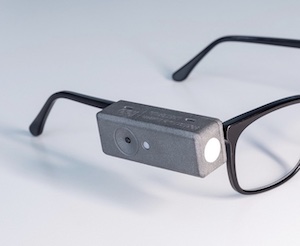
The light dosimeter developed by LUASA
Could the novel light dosimeter be deployed in the field in the UK? Participants in architecturally distinct workplace environments could monitor their ‘light dose’ for a week. Depending on the workplace context being different during this pandemic, it may be better to opt for ‘hybrid’ workplaces combining both traditional office and home working. Once the data is collected, a lighting metric (𝜶-opic daylight equivalent illuminance), recommended by the Commission Internationale de l’Eclairage (CIE) for good quality lighting, could be computed.
The immediate outcome of this type of project would be unique evidence-based data to describe the ‘light dose’ experienced in a variety of distinct workplace architectural environments. We could use these data to confirm proposed metrics in lighting quality and/or propose new ones and we could use these findings to contribute to the WELL building standard (International WELL Building Institute) and the Society of Light and Lighting’s (SLL) Codes and Guidance documents. Such a novel and wearable sensor for conducting real world research could inform the design of healthy buildings in the longer term.
Details of the light dosimeter can be found at be found https://light-dosimeter.ch/
Citation
@online{mansfield2022,
  author = {Mansfield, Kevin},
  title = {Field Utilisation of a Light Dosimeter},
  date = {2022-01-28},
  url = {https://kpmansfield.github.io/posts/2022-01-28/},
  langid = {en}
}